Restorative Practice Project
An extension of the Kindness On Purpose Way.
Summary: In the context of the NSW Department of Education’s current focus on strengthening restorative approaches, the Restorative Practice Project (RPP) was developed from a deeply practical belief: that repair, connection and relational skill building are essential life skills.
This project grew in response to the NSW Department of Education’s (the department) renewed focus on restorative practice in 2025 which included the recognition that behaviour isn’t just compliance to rules but an expression of emotional needs, social understanding and relational dynamics. The department defines restorative practice as a whole-school teaching and learning approach that nurtures supportive, respectful behaviour by building, maintaining and restoring positive relationships. Further, the department “acknowledges there are a variety of factors that influence behaviour” and an effective restorative practice approach will seek to address the underlying influences through empathy, relationship-building, communication, social and emotional learning and finding ways to respectfully hold one another accountable.” (NSW Department Of Education, Behaviour and Engagement, What Is restorative Practice?)
This Restorative Practice Project (RPP) brings a trauma-informed, neuroscience-based lens to this work. It honours that brains under stress, pain or conflict cannot access the higher-order thinking needed for reflection and rational decision-making and that any process meant to support growth must first meet the neurobiological needs for safety and connection. When shame and embarrassment arise after harm, behaviour can look messy, avoidant, defensive or withdrawn, and a restorative response must understand this context before it can guide repair.
At its core, the RPP is grounded in the conviction that relationships are the context for learning, and repair is essential for safety and growth. It honours that when children and adults alike develop emotional literacy, regulation, and relational competence, school culture shifts: behaviours are understood instead of merely managed, connection becomes proactive, and conflict becomes an opportunity for insight rather than exclusion.
Restorative practice, when understood deeply, equips school communities with:
Relational and emotional skill development - empathy, reflection, accountability, and self-regulation.
Cultural change - language, norms and practices that reinforce belonging and contribution
Practical, evidence-aligned tools that work within real classrooms and real lives.
Leadership alignment - shared frameworks that bring consistency and coherence.
Student voice and agency, which in turn invites every person into the work of community and repair.
The RPP builds on the Kindness On Purpose framework, extending its core concepts into structured resources and a professional learning system that helps schools meet both local need and broader policy direction with integrity, compassion, and skill.
The following resources extend the Kindness On Purpose Way into practical, trauma-informed restorative tools designed for everyday school contexts.
Restorative Practice Project: Training and Resources
The following restorative practice resources have been developed in alignment with the NSW Department of Education’s ongoing emphasis on restorative practice across school communities.
The resource package includes:
A short overview video outlining the core framework and restorative practice tool
The primary restorative practice tool
Professional learning training module videos
Supporting materials to assist with the practical implementation
Content for inclusion in the Staff Bulletin
A troubleshooting section to support the implementation of the RPP into your school.
Poster PDFs to display posters in the classroom and offices to provide visual cues for learning.
These materials are offered as a resource to support and strengthen any existing Kindness On Purpose or well-being practices currently in place at your school. They are designed to complement existing systems and provide practical structure and shared language for restorative conversations with students.
The resources are shared with the intention of supporting staff and enhancing relational practice across the school community. Links and attachments are included below for ease of access.
Restorative Practice: The Project Overview
Restorative Practice: The Project Overview Link: https://youtu.be/tDklB5hP5NQ
Restorative Practice Project Professional Learning Modules:
Restorative Practice Project Module 1: Introduction and Welcome Link: https://youtu.be/CVtWYbsUCb4
Restorative Practice Project Module 2: One Aspect of Trauma-Informed Care Link: https://youtu.be/9ToBJr52BM0
Restorative Practice Project Module 3: Setting Direction and Your Values In Practice Link: https://youtu.be/qfZpqs4HBz0
Restorative Practice Project Module 4: NSW Department Of Education On Restorative Practice Link: https://youtu.be/i6xrMbexd9k
Restorative Practice Project Module 5: The Link Between Brain and Behaviour Link: https://youtu.be/xtQszkYVKnQ
Restorative Practice Project Module 6: The Repair Process Tool Link: https://youtu.be/_9_K2LxW8m8
Restorative Practice Project Module 7: Lesson Plan for Heavy and Light Feelings Link: https://youtu.be/n0FV1rdbajw
Additional Content Videos:
4 Steps to Emotional Regulation – Teaching students how to look after their feelings Link: https://youtu.be/mWt2UaQZpGc
About The Circle Conversation Link: https://youtu.be/iQj0e6Cb3M4
The Circle Conversation Training Video Link: https://youtu.be/G3EqkmLKAXU
Resources:
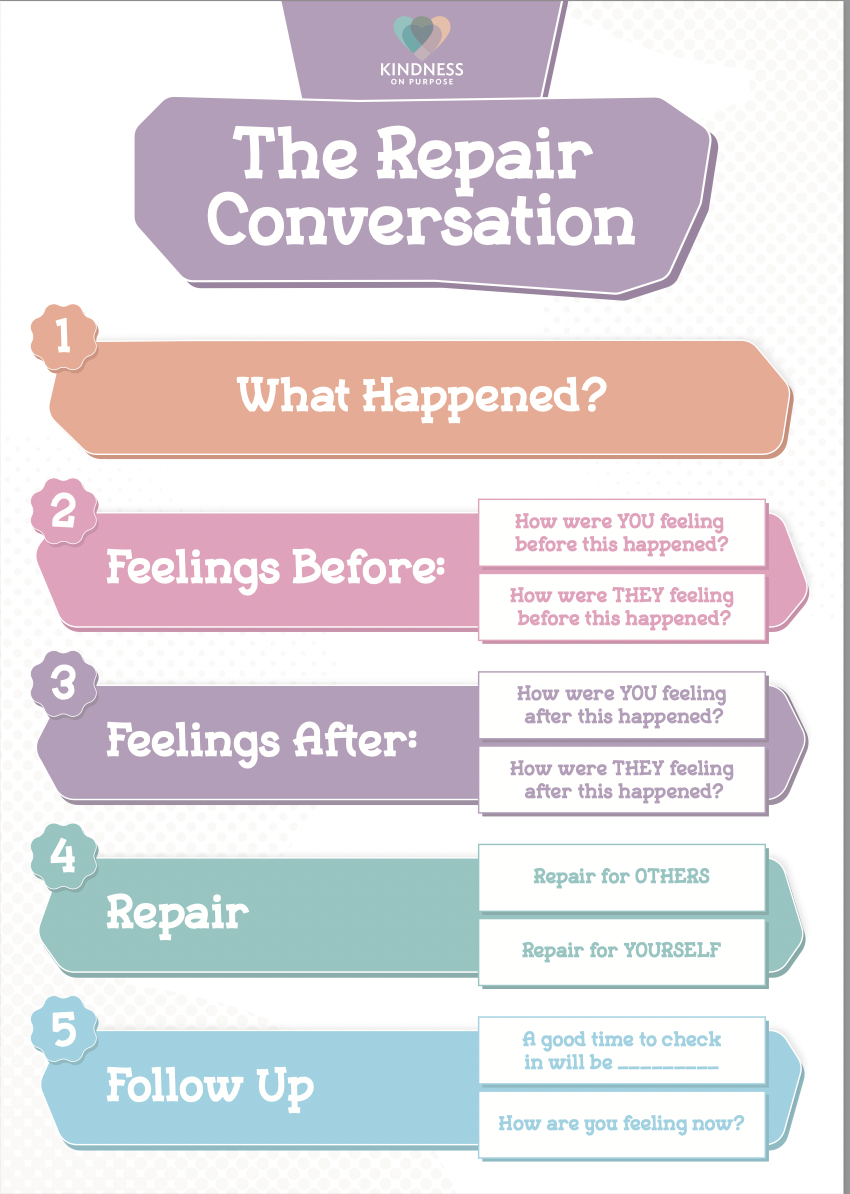
CORE TOOL: The Repair Conversation Tool link here
POSTER: Download 4 Steps Looking After My Feelings - link here
POSTER: Download The Repair Conversation link here
Restorative Practice Teacher Lesson: Heavy and Light Feelings link here
Values for Restorative Practices link here
Troubleshooting:
Troubleshooting - Restorative Practice Project Troubleshooting Guide link here
Troubleshooting Video: link here
Staff Bulletin Content:
12 x Content for the Staff Bulletin
Staff Bulletin 01 Why Restorative Practice Supports Students link here
Staff Bulletin 02 A Language of Safety – Why One Word Can Be Enough link here
Staff Bulletin 03 When “Heavy” Feels Too Soft - helping stage 3 boys find safe emotional language: link here
Staff Bulletin 04 What The Brain Needs After Conflict link here
Staff Bulletin 05 Why Restorative Practices is a Strong Fit For Our School link here
Staff Bulletin 06 When Holding Hope Feels Overwhelming—Teacher Fatigue and ‘one more thing’ link here
Staff Bulletin 07 Restorative Practice Begins With Values, Not Questions link here
Staff Bulletin 08 Why Restorative Practice Matters - beyond policy, link here
Staff Bulletin 09 Rebuilding Empathy: Noticing Self and Others link here
Staff Bulletin 10 Accountability Without Shame: Behaviour Is Something We Do, Not Who We Are link here
Staff Bulletin 11 Repair for Others AND Repair for Self link here
Staff Bulletin 12 Small Moments Are Restorative Practice link here
Additional Resources:
The Circle Conversation Script link here
Are you a circle shape or a wobbly shape? link here